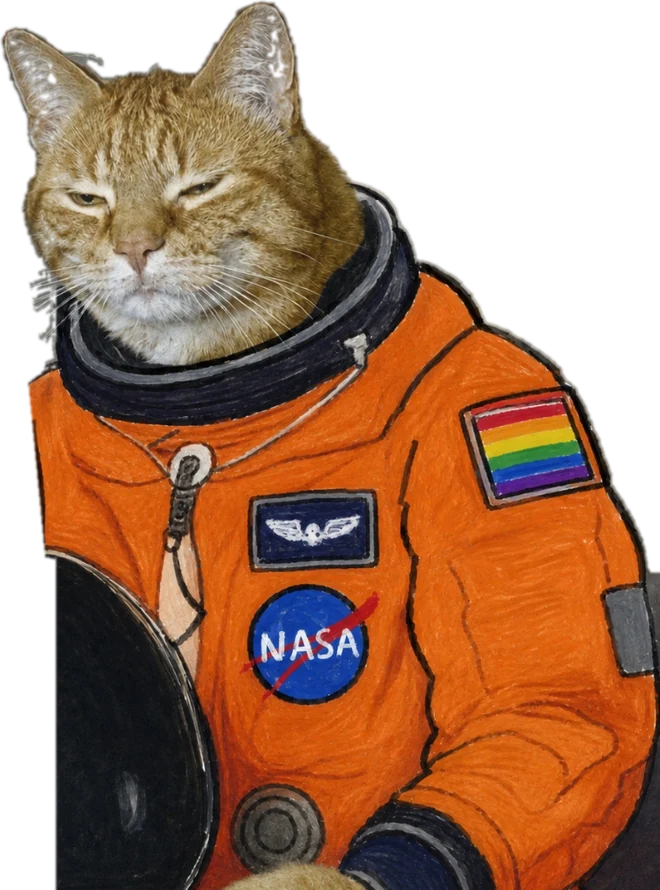
the record
the only cat that ever flew
France put a stray from the streets of Paris on a Veronique AGI 47 on
18 october 1963 at 08:09, with nine electrodes implanted in her skull
and two more glued to a foreleg to shock her mid flight. She was catalogue
number C 341, one of fourteen cats bought from a dealer, and she weighed
2.5 kg. The flight lasted 13 minutes, five of them weightless, at 152 km,
and she pulled 9.5 g going up. She came back alive. About two months later she
was euthanised so her brain could be sectioned.
A second cat went up on 24 october, an explosive bolt failed, and it was dead
before anyone reached the capsule. The press had already renamed the first one
Felix, and Comoros in 1992, Chad in 1997 and Niger in 1999 all printed stamps
with a male cat and the wrong name on them. There is a bronze of her at the
International Space University in Strasbourg, unveiled on 18 december 2019,
paid for by strangers on the internet.
the maneuver is real, and it is not a reflex
The turn in the window is T. R. Kane and M. P. Scher, A dynamical explanation
of the falling cat phenomenon, International Journal of Solids and Structures 5
(1969) 663 to 670, written at Stanford on NASA grant NGR-05-020-209. Their
cat is two cylinders joined at a point that bend but never twist, and the whole
argument is that the angular momentum stays at zero the entire time, so nothing
is pushing against anything.
The one number they could not derive they measured: the ratio of axial to
transverse moment of inertia, 0.25, taken with Dr James Robinson of NASA
Ames on fourteen segments of a dead cat. Their published pair of bends,
116 degrees forward and 25 back, read off the Life photographs of a falling cat,
turns the model through 179.899 degrees in one cycle. That is the number
this page starts on, and the exact half turn sits at a forward bend of 116.1.
a space station learned it in 2006
Turning a spacecraft normally costs fuel. On 5 november 2006 the
International Space Station was rotated 90 degrees without firing a thruster,
and on 3 march 2007 it was turned all the way round, 180 degrees, the
same way: stored momentum in the gyros and the torque the environment hands you
for nothing. Draper Laboratory called it a Zero Propellant Maneuver. The same
rotation on thrusters had burned 110 pounds, about 50 kg, and propellant
up there runs over 20,000 dollars a kilogram.
An astronaut outside carries less than that. The rescue pack on the back of a
suit, SAFER, holds 1.4 kg of nitrogen and 3.05 m/s, once, for the
rest of the walk. Bruce McCandless flew 98 m from the shuttle on
7 february 1984 with a bigger one and every metre of it was budgeted.
the part he cannot do
In 1957 two US Air Force researchers put eight kittens in T-33 and F-94
jets flying parabolas and let go of them. S. J. Gerathewohl and H. D.
Stallings, The labyrinthine posture reflex in the cat during weightlessness,
Journal of Aviation Medicine 28(4), august 1957: the righting reflex is
almost completely lost when there is no gravity. The mechanics work anywhere.
Knowing which way you want to end up is an organ in the inner ear, and that
organ needs a down.
So he can turn, precisely, forever, for nothing, and no part of him knows where
to stop. The last vehicle this ground launched on a stunt was a car with a
dummy in it, on 6 february 2018, still going round the sun every 557 days
with a 6 percent chance of hitting the Earth inside a million years. Nobody sent
that one a flight plan either.